Showing posts with label archivexchange. Show all posts

Friday, March 20, 2009

ArchiveXchange - Archive Attender 3.5 released!

The Azaleos offering for ArchiveXchange is making strides!   Thanks to our friends at Sherpa Software hearing our input, as well as our customers' input, we now have access to new and exciting features to work with.

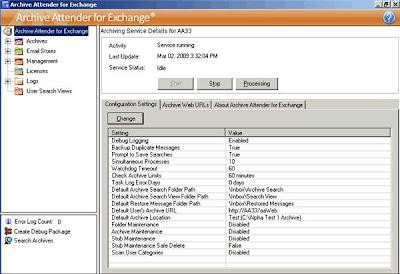
The console has been overhauled:


An auto aging stub feature has been added:


All stub activity can now be acted upon based on criteria, and best of all for my practical purposes, archive auto creations!   Auto archive creations based on thresholds are essential for keeping maintenance windows small, especially when journaling.  It allows admins to essentially have 'save points' where data ceases to change, and thus, remains more stable in the isolated environment.  Maintenance need only be run against the deltas!

Another benefit to upgrading is the new web-based search features.  As the product continues to evolve toward a hybrid product, more options open up to users as to if they want full reliance on stubs, searching, or both.


The listed upgrades combined with other admin and user bound benefits make this a great release, and a product worth watching when comparing to other technologies.

Wednesday, December 3, 2008

Archive Attender - HTML Formatting on x64

As a followup to my previous blog located here, this issue has now been resolved.  With combined efforts of Azaleos and SherpaSoftware, we have successfully rolled out this update to our first 6 clients.  It was much anticipated, and has been well received so far.

Thursday, October 23, 2008

Journaling + Archive = Ideal Litigation Searches -- Part 3 ?

Some notes when installing Journaling with archiving..this is sort of a part 3 to my previous two blogs.  

The more journaling mailboxes you utilize, the more you can take advantage of Archive Attender multithreading.  It is hard capped at one thread per mailbox though.  In order to ensure archiving keeps up in the event of a failure (especially if you are using a single journal mailbox), a good idea is to have tiered archiving policies as sort of layered message traps by date:


An example of the policy to be on the front line would be:


Other policies would be between dates, with the final policy applying to anything older than the second to last policy's criteria.

I've noticed significant improvement once policies were added.  This method also sort of safe guards you against back logs by already have a system in place to deal with them.

If you are bent on journaling at the Hub Transport level, you may want to at least split internal and external mail into two different mailboxes.  If you are journaling at the database level, then you could go as far as to have a separate journal mailbox for each database.

Tuesday, September 9, 2008

Journaling + Archive = Ideal Litigation Searches -- Part2

Abstract

While Custom Views are good for a quick search from your Inbox, sometimes legal departments require an export to PST for burning to CD etc. This area is where Archive Search comes in (or Discovery Attender once the integration happens in the next release!).

Directions

Log on to the archive server, and open AAConsole.exe. Choose Archive Locations from the left hand column, then right click in the white space and choose “Search Archive..” (or alternatively click the magnifying glass.)

Fill out the information to choose which archives to search, sender/recipient, etc. Click Search.

Highlight the emails you wish to export. Right click and choose “Copy Selected Messages to a PST…”

To pull from a specific folder structure, simply sort by folder (scroll to the right in the screen shot).

Enter the location of your PST..and done!

Conclusion

This process is the perfect procedure for compliance related exports for your legal department. With journaling active in the Exchange site, it is much easier to simply query the journaling mailbox instead of single mailboxes.

Journaling + Archive = Ideal Litigation Searches -- Part1

Requiring litigation searches has been a long standing topic for most IT departments. The issue is how to deploy a method to do this that both appeases the litigation team in question, while allowing for the Journaling mailbox to not become encumbered to the point that it ceases to properly function.

My answer is one that I have been deploying to the field in a solution comprised of Exchange journaling, and SherpaSoftware’s Archive Attender.

I set up Journaling at the Hub Transport level in order to catch everything that passes through. This will inherently catch more traffic than setting up Journaling at the database level, and provide the litigation team all of the raw emails they need. The only complications with this are determining the folder structure to which these messages used to belong, and the fact that the Journaling mailbox could quickly grow out of control. The assumption of growing out of control is caused by either a lack of retention restrictions, or depending on the project requirements, poor planning.

That being said, I prefer to use a single Journaling mailbox on its own storage group and database in combination with Archive Attender. The reason for this is that there need not be any prior knowledge of message location, and the search speed is still relatively quick in Archive Attender. It is possible to break these out at the database level which could result in quick searches, but more personnel overhead and management. Something to consider:

We need to create a rule on the Journaling mailbox to pipe all unwanted emails (items such as backup notifications that will never have legal relevance) to some folders to be deleted prior to them being archived. This will save on storage if you have a process that continually sends generic emails or updates. The best way to do this that I know of is:

1. Create MRM policies, folders, and schedules.

a. Open the Exchange Management Console

b. Organization Configuration -> Mailbox -> Manage Custom Folders -> New Customer Folder

c. Create a folder for the items you want to delete.

d. Click the Managed Folder Mailbox Policies tab and create a new policy.

e. Go back to the Manage Custom Folders tab and expand the tree for the folder. Right click the content settings and click properties. Set retention to 1 day, and to delete permanently.

f. Apply the policy to the mailbox by right clicking on the Journal mailbox (under Recipient Configuration), clicking the Mailbox Settings tab, Messaging Records Management, and clicking properties. Choose the policy to apply.

g. Navigate back to Server Configuration -> Mailbox -> Right click Exchange Server and click on the Messaging Records Management tab.

h. Click customize and choose a schedule to run it. Depending on the volume of items going to this folder, you might want to run this a few times during the day.

2. We now need to create a rule in Outlook.

a. Open up Outlook for the Journaling mailbox. Create rules to pipe messages meeting X criteria to the managed folders you created upon arriving.

b. Even though it is best practice no to, we need to leave the Journaling mailbox visible by the GAL so that it is accessible by Archive Attender. We can offset this by only allowing Exchange to email it via:

Set-Mailbox journal -AcceptMessagesOnlyFrom "Microsoft Exchange" -RequireSenderAuthenticationEnabled $True

3. Now that the exceptions are done, we need to configure Archive Attender to run on the mailbox.

a. Create a policy that applies to all messages in the inbox, and archives them without a stub.

b. You will want this policy to run at least once per day if not 2-3 times.

c. You will also want to configure the policy to NOT archive the managed folder that we created by creating an exception in the folder list.

d. Under conditions choose ‘Capture all messages.’

e. The schedule is a dynamic setting that is based on your company size. This could range anywhere from every 10 minutes, to once per day. My default is to perform the task every 30 minutes to ensure that it doesn’t fall behind (if the processing power is there).

f. We will also want to ensure that the archive is searchable and that the policy as applied. Both of these can be set in the properties of the Journal user in Archive Attender.

4. We now have all mail that passes through the Hub Transport server going to the Journaling mailbox, parse for irrelevant mail to be purged, and then pushed off to the archives leaving no stub behind. This is good for a couple of reasons.

a. It provides an easy way to search mail, whether it is through Archive Attender, or another tool from SherpaSoftware called Discovery Attender (Slated to be fully integrated in their next release!)

b. It keeps the Journaling mailbox empty, and efficient!

This concludes part one. I will be writing up part two soon that will cover litigation searches in Archive Attender, and PST exports.


See here for part 2.
Tuesday, September 2, 2008

Archiving Policies - Hard limit, or Quotas?

I run into this constantly on the job. Many people like the simplicity of a hard set policy; IE archive everything 30 days old or older. My argument to this is that quotas, while requiring a bit more planning and foresight, are eventually much more dynamic and easily managed in the long run.


My personal preference is to set the archive quota to use the warning limit. This way, it is seamless to the user as it prevents the notifications, and doesn't hit the send/receive limit either. Another pro to using the warning quota in Exchange is that because they don't see a warning, they don't misinterpret what is going on and try to archive it themselves. This is compounded if the ability to use PSTs has not been disabled via group policy. Hard set limits such as nothing in the last 7 days will help with potential user grief (especially if the slider on the quota limit tab is set toward size rather than date). Also setting the "Do not archive messages smaller than" setting is good to set so that it mitigates the frustration of having to pull down an archive that didn't really get any size savings anyways. Stubs tend to be around 2-3kb, so that part is a no brainer. I like setting it a bit higher due to the balance of overall size savings versus user acceptance. Again this is a culture based decision.


The quota limit tab is another place decisions come in to play. You'll want to set the percentage of the quota to begin archiving from to at least be less than what the person could receive in a day. That number also affects how far down to archive. The size versus message age debate is one of, surprise, culture. If your company receives a barrage of large images for viewing/editing, you'll obviously take different steps than if your business relies on email primarily as a quick messaging service.


Now to the dynamic part. The best part about this system is that you only need one policy. This means no messing with automation policies down the road, no messy clean ups, etc. Merely change the quota limit in Exchange for the mailstore or individual and viola. Powershell scripts in Exchange 2007 make this a very powerful solution!